Why does the Moon change shape?
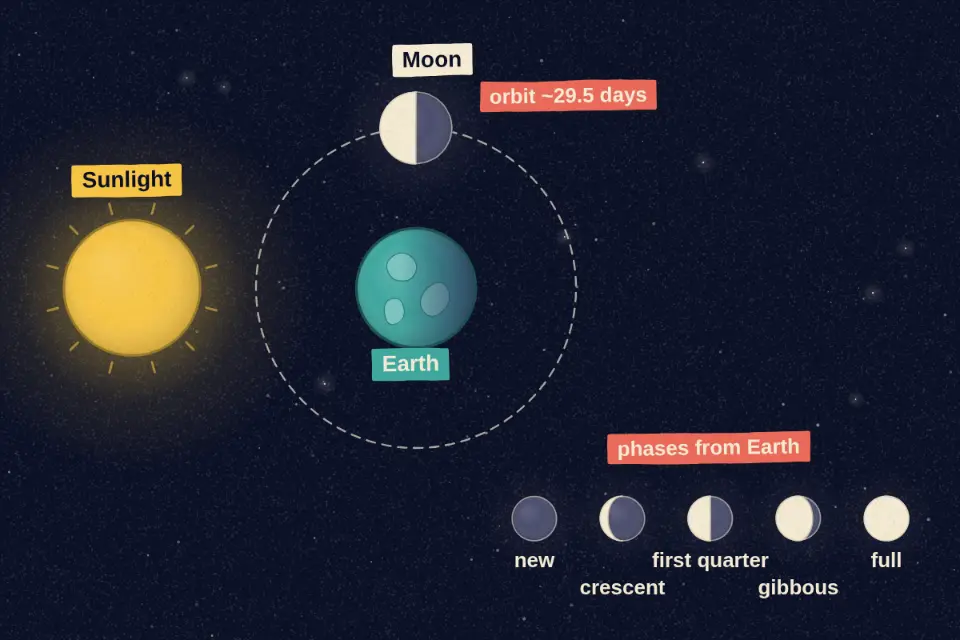
The Sun always lights up one half of the Moon. As the Moon circles Earth every 29.5 days, we see a different share of that lit half, from none of it (new moon) to all of it (full moon).
Why tho? Three levels deeper
Why don't we see the dark half?
The dark half faces away from the Sun, so it sends no sunlight back to us. At new moon the dark half faces Earth completely, and the Moon is nearly invisible.
Isn't the dark part Earth's shadow?
No, that's a common mix-up. Earth's shadow only falls on the Moon during a lunar eclipse, and that can only happen at full moon. The phases come from our viewing angle, not from a shadow.
Then why isn't there an eclipse every month?
The Moon's path is tilted about 5 degrees compared with Earth's path around the Sun, so most months the Moon passes just above or below Earth's shadow.
Half lit, always
Like Earth, the Moon is a ball lit by the Sun on one side. What changes over the month is not how much of the Moon is lit, but how much of the lit side faces us.
The order of the phases
New moon, waxing crescent, first quarter, waxing gibbous, full moon, then the same shapes shrinking again: waning gibbous, last quarter, waning crescent. A full cycle takes about 29.5 days, which is where the idea of a month comes from.
Try it at home
In a dark room with one lamp, hold a ball at arm's length and turn slowly in a circle. The lamp is the Sun, your head is Earth, and the ball goes through every phase.
Check yourself
At full moon, where is the Sun compared with the Moon?
Answer
On the opposite side of Earth. That's why a full moon rises around sunset and sets around sunrise.