Why do we have seasons?
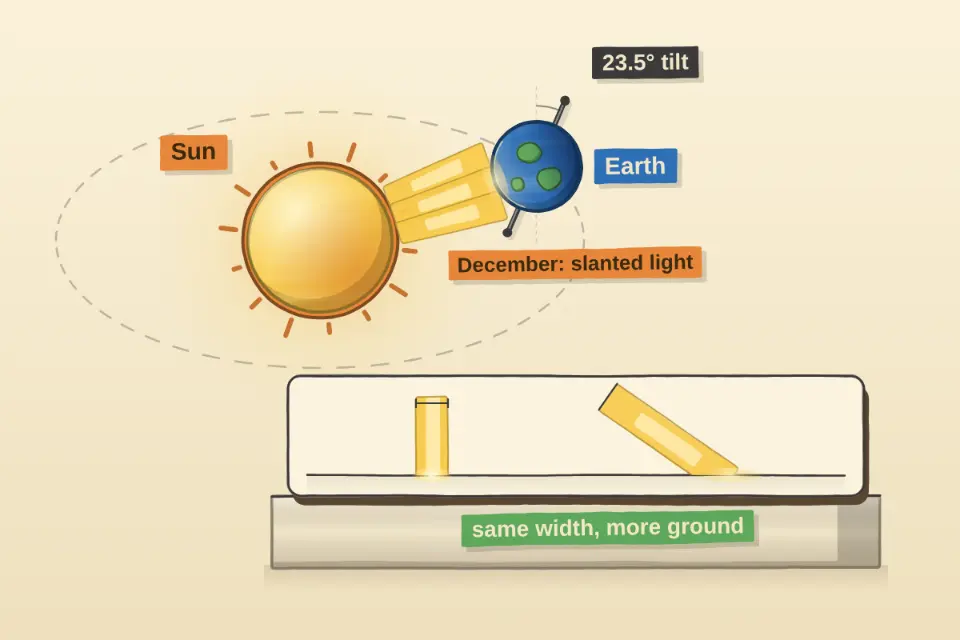
Earth's axis is tilted. For part of the year your half of Earth leans toward the Sun and gets steep, concentrated sunlight and long days; half a year later it leans away and the same light arrives at a slant, spread over more ground.
Why tho? Three levels deeper
Why does slanted light heat less?
A beam of sunlight carries a fixed amount of energy. Hitting the ground straight on, it lands on a small patch; at a slant, the same beam is smeared over a much larger patch, so each square metre gets less energy and warms less.
Why are summer days longer?
Because of the tilt, the half of Earth leaning toward the Sun spends more of each turn of the planet in daylight. More hours of sunshine and steeper light together make summer.
Isn't it because Earth is closer to the Sun in summer?
No. Earth is closest to the Sun in early January, during winter in the northern half. Its distance only changes by about 3% over the year, far too little to cause the seasons.
The tilt does it
Earth spins around an axis tilted about 23.5 degrees, and that axis keeps pointing the same way in space as Earth travels around the Sun. So in June the northern half leans toward the Sun, and in December it leans away.
Two effects at once
- The angle of the light. Steep light is concentrated; slanted light is spread out. Shine a flashlight straight down on a table, then tilt it: the same light covers a bigger, dimmer oval.
- The length of the day. Leaning toward the Sun means more hours of daylight in each 24 hours.
Why the equator barely has seasons
Near the equator the Sun is high in the sky all year and days stay close to 12 hours long, so temperatures change much less from month to month.
Check yourself
When it's summer in Canada, what season is it in Australia?
Answer
Winter. When the northern half leans toward the Sun, the southern half leans away from it.