Why do leaves change colour in autumn?
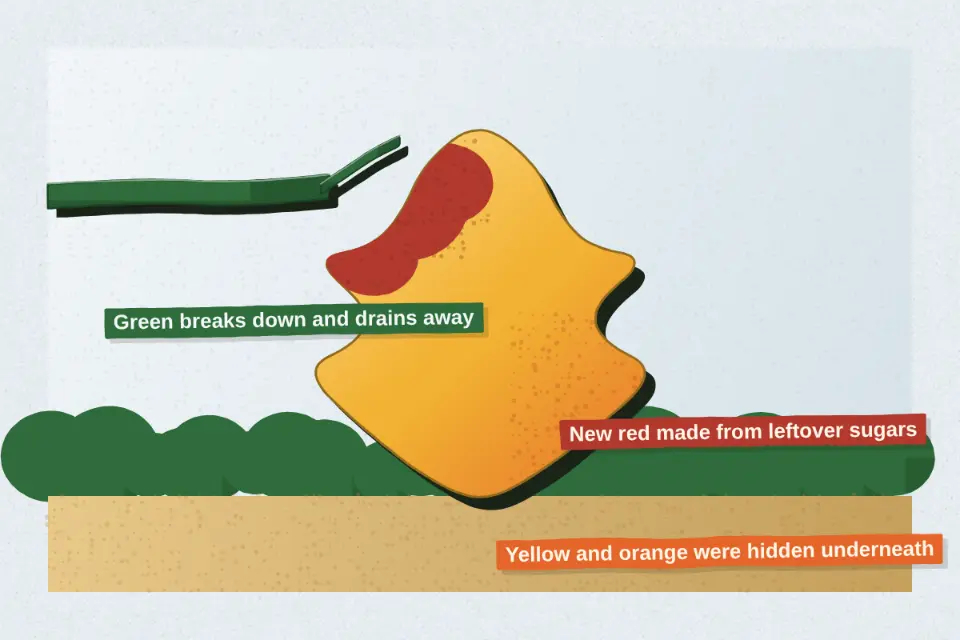
Leaves are full of green chlorophyll that hides yellow and orange colours underneath. As autumn days shorten, the tree breaks the chlorophyll down, the green fades, and the hidden colours show; some trees also make new reds.
Why tho? Three levels deeper
Why does the tree break the green down?
Chlorophyll is rich in nitrogen, which is precious to a tree. Before dropping its leaves, the tree breaks the chlorophyll down and pulls the nitrogen back into its branches to reuse in spring.
Where do the reds come from?
Reds and purples are new: in autumn some trees make pigments called anthocyanins from sugars left in the leaf. Sunny days and cool nights trap more sugar in the leaves, so the reds are brighter.
Why do the leaves fall?
A layer of cells forms where the leaf stalk joins the branch and seals it off. Without leaves, the tree loses far less water through the winter, when the ground may be frozen.
Two kinds of colour
- Yellow and orange (carotenoids) are in the leaf all summer, hidden by the green.
- Red and purple (anthocyanins) are made fresh in autumn.
The trigger
It's mostly the length of the day. As nights get longer, trees start shutting down their leaves, whatever the temperature.
Why some years are more colourful
A dry, sunny autumn with cool (but not freezing) nights gives the most brilliant reds.
Check yourself
Why are maple colours often brightest after sunny days and cool nights?
Answer
Sunny days make sugar, and cool nights keep it in the leaf, where it becomes red pigment.