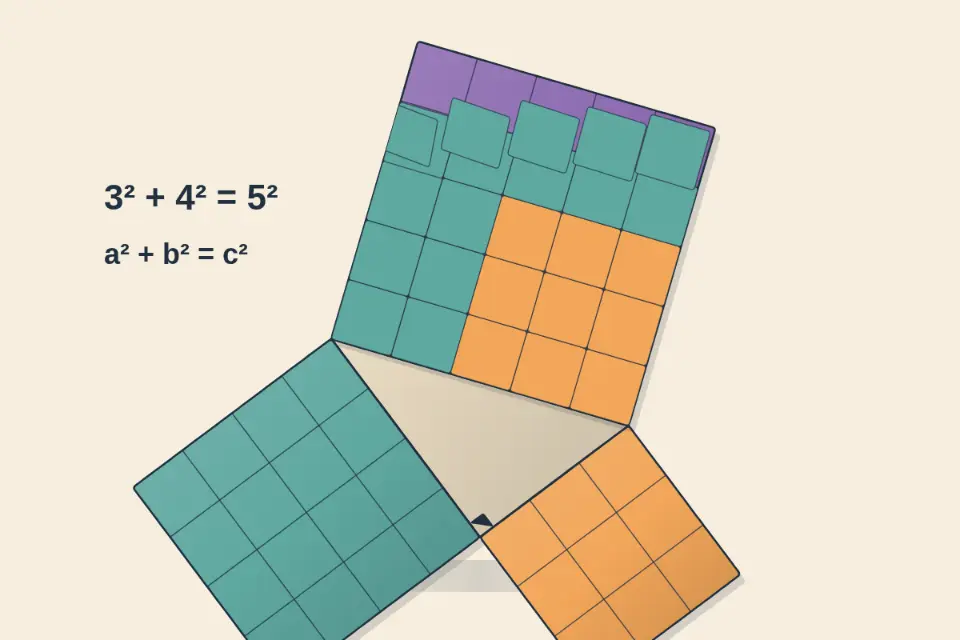
The Pythagorean theorem, shown with squares
In any right triangle, the square built on the longest side has exactly the same area as the two squares on the other sides put together: a² + b² = c².
Why tho? Three levels deeper
Why does it always work?
Put four copies of the triangle inside a big square of side a + b. Arranged one way, the empty space left is one tilted square of area c². Arranged another way, it's two squares, a² and b². Same big square, same triangles, so the empty spaces are equal.
What about triangles without a right angle?
Then you need an extra term: c² = a² + b² − 2ab·cos(C), the law of cosines. At a right angle, cos(90°) is 0 and the extra term disappears.
Where is it actually used?
Everywhere distances are measured: the straight-line distance between two points on a map or a screen is √(Δx² + Δy²), and builders check right angles with a 3-4-5 rope.
Count the squares
With sides 3, 4 and 5, the squares hold 9, 16 and 25 little unit squares. And 9 + 16 = 25. That's not a coincidence of those numbers: it holds for every right triangle.
Which side is c?
c is always the hypotenuse, the longest side, opposite the right angle. Mixing up which side is c is the most common mistake.
Famous whole-number triangles
3-4-5, 5-12-13 and 8-15-17 are right triangles with whole-number sides, called Pythagorean triples. Double one and you get another: 6-8-10.
Check yourself
A 5 m ladder leans on a wall and reaches 4 m up. How far is its foot from the wall?
Answer
3 m, because 3² + 4² = 9 + 16 = 25 = 5².