How does a lever make lifting easier?
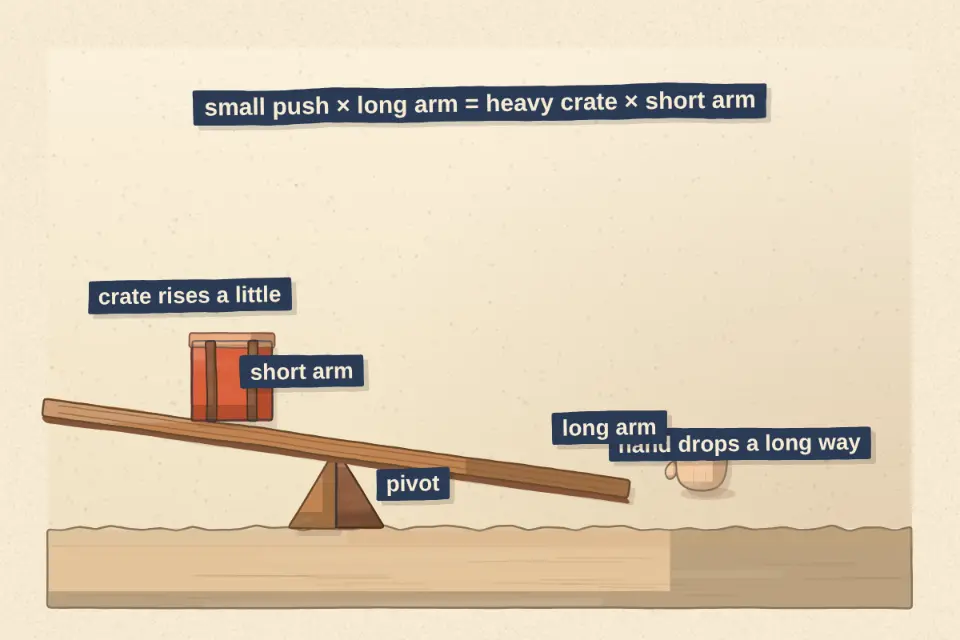
A lever trades distance for force. Push down far from the pivot and a small force can lift a heavy load close to the pivot, because force times distance balances on both sides.
Why tho? Three levels deeper
Why does the distance from the pivot matter?
What turns a lever is force times distance from the pivot (called torque or moment). Twice as far out, half the force gives the same turning effect.
So is it free energy?
No. Your hand moves a long way while the load moves a short way. The work (force × distance moved) is the same on both sides; a lever makes the push smaller, not the work.
Are there levers in my body?
Yes. Your forearm is a lever with the elbow as the pivot. The biceps attaches very close to the elbow, so it needs a big force, but in return your hand moves fast and far.
Three parts
Every lever has a pivot (the fulcrum), a load, and an effort (your push). Seesaws, crowbars, scissors, bottle openers and wheelbarrows are all levers.
The rule
Effort × its distance from the pivot = load × its distance from the pivot. Archimedes put it boldly: give me a place to stand and a lever long enough, and I will move the world.
Three classes
Pivot in the middle (seesaw), load in the middle (wheelbarrow), or effort in the middle (tweezers, your forearm).
Check yourself
A 40 kg child sits 1 m from a seesaw's pivot. Where must a 20 kg child sit to balance?
Answer
2 m from the pivot: 40 × 1 = 20 × 2.